
The takeaways
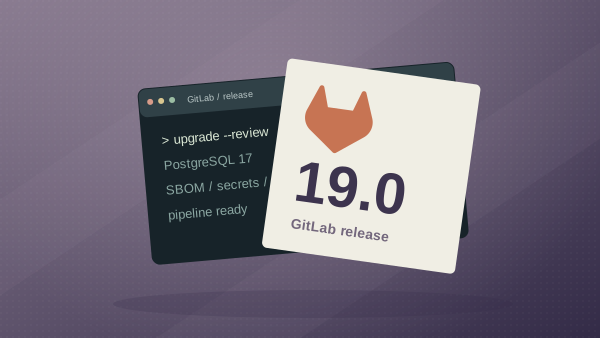
- GitLab 19.0 upgrades require database, operating-system, and agent-approval checks.
- Kernel patching matters for CI runners and build hosts as well as production nodes.
- Test RKE2 upgrades across ingress, networking, and runtime components together.
In this episode
Highlights & Key Takeaways
🧰 Tool-by-Tool Briefing
Quick Update: This refresh focuses on May 15 through May 22, 2026. The biggest themes are GitLab 19.0 upgrade planning, agent governance, Linux kernel runtime risk for cluster nodes and CI runners, SonarQube analyzer updates, Keycloak authorization direction, and supply-chain workflow controls in Nexus and Repository Firewall.
GitLab
- Release / Platform: GitLab 19.0 shipped on May 21, 2026 with group-level GitLab Duo review instructions, configurable work item types, GitLab Secrets Manager in open beta, SBOM-based dependency scanning GA, and deeper CI/CD catalog usage analytics. (GitLab 19.0)
- Security / Compliance: The 19.0 upgrade has several self-managed breaking changes: PostgreSQL 17 is now the minimum, Ubuntu 20.04 and SUSE Linux packages are discontinued, Redis 6 support is removed, and bundled Mattermost is gone. (GitLab 19.0, GitLab breaking changes)
- AI / Automation: GitLab Duo Developer can now be triggered by assignment, Generate MR, or
@mention, and GitLab added per-session tool approvals plus admin controls for agentic chat. Treat that as a governance feature, not just a convenience feature. (GitLab 19.0) - Developer Experience: GitLab Duo Agent Platform Self-Hosted added broader open-source model support for regulated or air-gapped environments, including Devstral 2 123B, GLM-5.1-FP8, and related options served through local infrastructure. (GitLab self-hosted models)
- Action Items: Before upgrading self-managed GitLab, validate database, OS, Redis or Valkey, Helm chart networking, bundled service usage, and GitLab Duo approval settings in staging.
Kubernetes
- Release / Platform: Kubernetes lists 1.36.1 as the latest 1.36 patch release, released May 13, 2026. The 1.36 line is now the active upstream branch to track for managed-service and distro adoption. (Kubernetes releases)
- Security / Compliance: CVE-2026-46333 is a Linux kernel ptrace-path flaw disclosed by Qualys that can let an unprivileged local user disclose sensitive root-owned files and execute commands as root on affected default Linux installs. Mitigation is kernel patching, distro guidance, and temporary ptrace hardening where advised. (Qualys CVE-2026-46333, NVD CVE-2026-46333, Ubuntu mitigation)
- AI / Automation: For Kubernetes, this is a runtime-risk reminder for AI agents, CI jobs, and build pods: local privilege escalation bugs matter more when untrusted or semi-trusted workloads share nodes.
- Developer Experience: Kubernetes 1.36 continues to push native controls like user namespaces, fine-grained kubelet authorization, MutatingAdmissionPolicies, and declarative validation. That reduces the amount of custom platform glue teams need to maintain. (Kubernetes 1.36, Declarative validation GA)
- Action Items: Prioritize kernel patch status for Kubernetes nodes, CI runners, and build hosts; enforce RuntimeDefault seccomp and restricted pod standards where possible; and keep 1.36 API deprecations in upgrade runbooks.
RKE2
- Release / Platform: SUSE’s RKE2 v1.36 support matrix now lists v1.36.0+rke2r1 with Kubernetes v1.36.0, containerd v2.2.3-k3s1, runc v1.4.2, Traefik v3.6.16, Cilium v1.19.3, and Calico v3.32.0. (RKE2 v1.36 matrix)
- Security / Compliance: None this week. The practical compliance note is version evidence: RKE2 upgrades include Kubernetes, runtime, ingress, CNI, and add-on versions that auditors may ask for separately.
- AI / Automation: None this week. If agentic tooling is proposing cluster upgrades, make it output the full bundled component delta, not just the Kubernetes minor version.
- Developer Experience: RKE2 v1.36 adoption will make teams revisit ingress, CNI, runtime, and admission policy assumptions together instead of treating the upgrade as a single binary bump.
- Action Items: Build a staging matrix for RKE2 v1.36 that includes ingress behavior, CNI policy, Fleet or Argo CD deployment paths, and node-level kernel remediation status.
SonarQube
- Release / Platform: SonarSource announced SonarQube Server 2026.3 on May 20, 2026, highlighting deeper language intelligence with 70+ advanced Python rules for issues like memory bloat and OOM risk. (SonarQube 2026.3)
- Security / Compliance: SonarQube Server release notes for the 2026 line include AI and mobile compliance reporting such as OWASP Top 10 for LLM and OWASP MASVS in Enterprise edition and above. (Sonar release notes)
- AI / Automation: The release direction is useful for AI-assisted coding: stronger analyzers and AI code assurance help teams verify generated pull requests instead of trusting them because they compile.
- Developer Experience: New analyzer rules can create new findings on unchanged code. Developers need a heads-up so quality gate changes are not misread as fresh regressions.
- Action Items: Test 2026.3 analyzers against representative repos, publish expected rule changes, and decide whether AI/mobile compliance reports belong in regulated project templates.
Keycloak
- Release / Platform: Keycloak published a May 20, 2026 note that 26.7.0 will include experimental OpenID AuthZEN Authorization API 1.0 support, allowing Keycloak to act as a Policy Decision Point behind a standard authorization API. (Keycloak AuthZEN)
- Security / Compliance: This is experimental and should not be treated as production-ready authorization. It is still important because standardized authorization APIs could reduce custom policy integrations over time.
- AI / Automation: AuthZEN is relevant to agentic workflows because agents need clear policy decisions for “can this identity do this action on this resource?” instead of broad tokens and custom checks.
- Developer Experience: Fine-grained admin permissions for organizations are also planned in 26.7.0, which should help multi-tenant identity administration avoid realm-wide permissions. (Keycloak organization FGAP)
- Action Items: Track 26.7.0 in a lab realm, map AuthZEN and organization FGAP to tenant admin use cases, and keep production authorization on supported Keycloak features until the experimental label is removed.
Sonatype Nexus Repository / Repository Firewall
- Release / Platform: Nexus Repository 3.92.0 landed on May 7, 2026, and 3.92.2 was available by May 14. The line adds Pub support, Conda hosted/group repositories, Helm group repositories, Nexus One UI preview, and database connection pool metrics. (Nexus 3.92 release notes, Sonatype community)
- Security / Compliance: Repository Firewall added webhooks for blocked or quarantined components and bulk waivers for multiple policy violations. Bulk waivers are powerful, but broad all-version waivers can become a long-lived exception if they are not scoped and expired carefully. (Nexus 3.92 release notes, Firewall bulk waivers)
- AI / Automation: Firewall webhooks are useful for automated quarantine workflows, Slack routing, and ticket creation; waiver approval should stay human-controlled in regulated environments.
- Developer Experience: Pub, Conda, and Helm group support reduces the need for side repositories or custom proxy patterns, which makes artifact access more consistent for application teams.
- Action Items: Upgrade test instances to 3.92.2, review Java 25 readiness for 3.93.0, wire Firewall events into your alert flow, and define a waiver policy with expiration, reason, and ticket requirements.
AWS GovCloud / Containers
- Release / Platform: AWS announced on May 20, 2026 that ECS now supports native Amazon EBS volume attachment in AWS GovCloud Regions for EC2, Fargate, and Managed Instances launch types. (ECS EBS GovCloud)
- Security / Compliance: This is not EKS, but it matters for GovCloud container strategy because stateful workloads can now use ECS-managed EBS lifecycle handling in regulated regions.
- AI / Automation: Storage-heavy ETL, ML inference, and batch workloads may no longer need the same amount of custom volume orchestration if ECS is acceptable for the workload.
- Developer Experience: Platform teams get another container option for stateful tasks that do not need the Kubernetes control plane.
- Action Items: For GovCloud workload intake, explicitly compare ECS with EBS task attachment against EKS for stateful batch, ML inference, and operational jobs.
AKS
- Release / Platform: Microsoft Learn now notes that AKS node pools running Kubernetes 1.36+ cannot use Windows Server 2022, with Windows Server 2022 support ending later in the lifecycle. (AKS FAQ)
- Security / Compliance: No new Critical or High AKS advisory was confirmed from primary Microsoft sources in this seven-day window.
- AI / Automation: None this week. The automation angle is inventory: cluster upgrade bots should check OS compatibility before proposing Kubernetes 1.36.
- Developer Experience: Windows workload owners need early notice because node OS constraints can block what looks like a routine Kubernetes version upgrade.
- Action Items: Inventory Windows node pools, identify workloads still tied to Windows Server 2022, and add OS compatibility checks to AKS upgrade plans.
OpenAI Codex
- Release / Platform: On May 14, 2026, OpenAI announced Codex in the ChatGPT mobile app in preview on iOS and Android across all plans, including Free and Go. (Codex mobile)
- Security / Compliance: OpenAI’s Codex docs note account-security requirements such as MFA for email/password users and sandboxed cloud task environments. Treat mobile approvals as privileged SDLC activity, not casual chat. (Codex cloud docs)
- AI / Automation: Codex can be supervised from mobile while work continues on connected laptops, dev boxes, or remote environments, which changes how engineers approve long-running agent work.
- Developer Experience: Mobile review of diffs, tests, terminal output, and approvals can keep work moving, but it also raises the risk of approving infrastructure or code changes without enough context.
- Action Items: Define when mobile agent approvals are allowed, require MFA or SSO controls, and keep privileged repository or production changes behind normal merge approval policy.
Devin
- Release / Platform: Cognition introduced Devin Auto-Triage on May 18, 2026, positioning Devin as an AI first responder for bug reports, incidents, Slack messages, Linear issues, GitHub events, Sentry alerts, Datadog signals, schedules, and webhooks. (Devin Auto-Triage)
- Security / Compliance: Cognition says Auto-Triage is built for untrusted inputs and runs in secure, network-sandboxed environments with protections against prompt injection and data exfiltration. Verify those controls against your own data boundaries before connecting observability or ticketing systems.
- AI / Automation: The long-term memory angle is the key change: Devin can remember prior investigations, recurring issues, routing preferences, and related tickets.
- Developer Experience: This could reduce first-response toil, but it should not become an unreviewed incident commander with write access to production systems.
- Action Items: Start with read-only alert triage, connect low-risk repositories first, log every action, and require human approval before PR creation or incident remediation.
📰 Industry News
Quick Update: This section pulls from the Episode 3 newsletter folder and supporting community signals. Treat these as podcast prompts and workflow lessons, not vendor release facts unless linked to a primary source above.
- Agentic DevOps is moving into runbook territory: The episode folder had repeated themes around Claude Code workflows, AI SRE agents, Kagent on Kubernetes, Kubernetes MCP servers, and custom DevOps skills. The useful takeaway is to version prompts and skills, scope credentials, and review agent changes like code. (Claude DevOps workflows, Kagent on Kubernetes, Kubernetes MCP)
- Terraform testing is becoming normal hygiene: The Terraform three-layer testing article is a good discussion starter for regulated IaC teams. Plan output is not enough; use static checks, module tests, and environment-level validation before
apply. (Terraform testing) - Kubernetes education content is still in demand: Kubernetes diagrams, controller-manager explainers, CoreDNS pieces, and 1.36 walkthroughs keep showing up. That is a signal that platform teams should keep investing in plain-language runbooks and architecture diagrams. (Kubernetes diagrams, Controller manager explainer)
- MCP has a maturity problem, not an obituary: The “MCP is dead” thread is useful because it challenges weak demos and fragile integrations. For us, the lesson is to judge MCP servers by permission model, auditability, host support, and failure behavior. (MCP is dead)
- Runtime security content is getting sharper: The newsletter queue included Kubernetes runtime threat detection and eBPF/Cilium networking reads. This lines up with the current Linux kernel CVE pressure: know what ran, what it touched, and whether node isolation actually held. (Kubernetes runtime detection, eBPF and Cilium)
- CI/CD tool lists are less useful than control mapping: “Top 10 CI/CD tools” content can be a decent discovery list, but regulated teams should map tools to identity, secrets, artifact provenance, audit logs, and runner isolation before adopting anything. (CI/CD tools list)
- AWS networking and container strategy are still changing: The InfoWorld AWS networking piece and GovCloud ECS storage update are useful prompts for deciding when Kubernetes is required and when a simpler managed container service is enough. (AWS networking, ECS EBS GovCloud)
⚙️ Fun Tools and Reads
Scrunch: AI search visibility and site-audit tooling. Useful for seeing how AI systems interpret public product or documentation pages before those summaries become the first thing users read. https://scrunch.ai/
NanoClaw: Lightweight, self-hosted AI assistant alternative to OpenClaw with container isolation as the main security story. Good sandbox material for learning agent isolation patterns. https://github.com/qwibitai/nanoclaw
Google Antigravity: Google’s agentic development platform for orchestrating software engineering agents. Interesting to compare against Codex, Claude Code, Devin, and local IDE-agent workflows. (Google Antigravity) https://www.antigravity.google/
Unframe: Operations AI-native tooling from the episode fun-tools list. Evaluate it through the same lens as any ops agent: integrations, approvals, audit logs, and rollback behavior. https://www.unframe.ai/
Metabind: Native MCP app platform that can publish interactive app experiences to Claude, ChatGPT, MCP hosts, or embedded assistants. Worth watching as MCP moves from plain text tools to richer UI surfaces. (Metabind) https://dev.metabind.ai/
Gemini 3.5 Flash: Google’s latest Flash model was presented as a faster, cheaper model for agentic workflows. Treat it as a benchmark candidate, not an automatic default. (Ars Technica) https://ai.google.dev/gemini-api/docs/models
Gemini Spark: Google’s personal always-on agent concept from I/O coverage. The relevant DevSecOps angle is policy: persistent cloud agents need clear data, identity, and action boundaries. (Gemini Spark coverage) https://gemini.google.com/
Krea 2: Krea’s first in-house image model, focused on aesthetics and creative control. Useful for diagrams, episode artwork, or training visuals after human review. (Krea 2) https://www.krea.ai/
Devin Auto-Triage: AI first-responder workflow with long-term memory for incidents and bug reports. Interesting, but start with read-only triage before letting it open fixes. (Devin Auto-Triage) https://cognition.ai/blog/auto-triage
ChatGPT personal finance: OpenAI’s personal finance preview connects financial accounts for budgeting and planning. Not DevSecOps, but a strong privacy and consent case study for connected AI products. (OpenAI personal finance) https://openai.com/index/personal-finance-chatgpt/
Codex mobile: Codex is now in the ChatGPT mobile app preview, which makes agent supervision possible from a phone. Useful for workflow continuity, but approvals still need engineering discipline. (Codex mobile) https://openai.com/index/work-with-codex-from-anywhere/
Kubernetes Controller Manager Explained: A practical explainer for how the controller manager keeps cluster state converging toward desired state. https://learnkube.com/kubernetes-controller-manager-explained
A Networking Revolution at AWS: InfoWorld’s look at AWS networking direction is worth pairing with VPC Lattice, service networking, and Kubernetes ingress strategy discussions. https://www.infoworld.com/article/4169113/a-networking-revolution-at-aws.html