
The takeaways
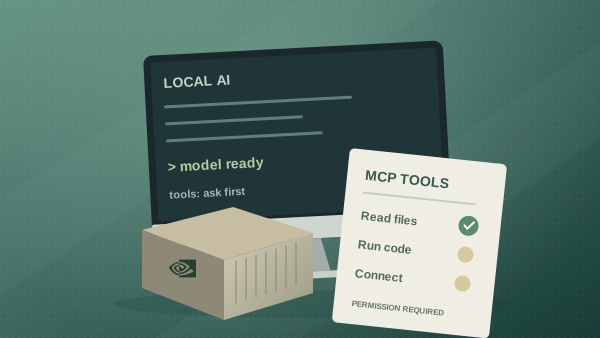
- Local AI hardware expands deployment options; model and tool permissions still need explicit boundaries.
- MCP governance brings approved-server lists and connection logging closer to coding workflows.
- Government AI delivery requires clear data-handling, audit, and deployment boundaries.
In this episode
In the News
DevOps Related News
- Git 2.56: Git’s September 28 contributor walkthrough covers new commands for dropping commits and updating references, plus remote object inspection that avoids downloading an entire object just to learn its size. These changes improve history maintenance and reduce unnecessary transfers in partial-clone workflows. Git contributor walkthrough
- GKE CPU startup boost: Google’s October 2 preview temporarily raises a container’s CPU allocation during startup, then lowers it after readiness without restarting the container. It works through the Vertical Pod Autoscaler, so applications can get extra initialization capacity without keeping oversized CPU requests for their entire lifetime. Google Cloud announcement
- Azure virtual-machine lifecycle: Microsoft’s September 28 policy defines Current, Extended, End of Life, and Retired stages for general-purpose, memory-, compute-, and storage-optimized VMs. Older stages can restrict new deployments or quota growth even while existing workloads remain supported, making VM generation part of infrastructure capacity planning. Microsoft’s lifecycle policy
- NVIDIA DGX Spark 64GB: NVIDIA announced a 64GB configuration on October 2, with partner availability starting October 23 and support for running AI workloads locally. Its Sync Cluster Assistant also connects two systems for larger workloads, extending the development path from one desktop machine to a small local cluster. NVIDIA announcement
- GitLab’s government AI workflow guidance: GitLab’s September 29 guide explains how Claude Code output can pass through existing merge-request reviews, scans, and approvals, with automated flows running on agency-operated runners. It distinguishes the fully self-hosted Duo Agent Platform from Dedicated for Government’s customer-deployed AI Gateway and chosen model provider; those are different deployment boundaries. GitLab’s guide
Cyber Security
- Veracode’s Azure DevOps scanning integration: Veracode’s September 30 release of Azure DevOps Extension 4.0.0 replaces the v3 scan and flaw-import tasks with v4 tasks and updates their dependencies; existing pipelines require manual migration on both Azure DevOps Cloud and self-managed Azure DevOps Server. Veracode also offers a FedRAMP Moderate platform in AWS GovCloud (US). Release notes · Government offering
- ZAP automated application testing: ZAP’s October 1 update completes the switch to Client Spider in its locally runnable nightly and weekly Docker builds and fixes alert-filter settings lost when automation plans were reloaded. Its new unified scan-policy manager has reached the weekly build, but remains an incomplete feature available only in dev mode. ZAP project update
- GrammaTech REAFFIRM 1.0: The October 1 release adds Kubernetes deployment through Helm, expanded SBOM analysis, and checks for whether vulnerable functions in binary artifacts are present, reachable, and exploitable. Its AI assistant can query analysis results and generate reports grounded in the underlying binary evidence. Release announcement
- Snyk Evo coding-agent controls: Snyk made MCP Governance generally available on September 30, adding centrally managed approved-server lists and local logging or blocking of tool connections made by Claude Code, Cursor, Codex, and GitHub Copilot. Snyk has a separate government edition, but the announcement does not establish Evo availability in that environment. GA announcement · Government edition and limits
- Harness LLMScanBench: Harness’s September 28 benchmark found that unattended LLM vulnerability scans varied across repeated runs and missed flaws despite high precision on three deliberately vulnerable test applications. This is vendor-run research comparing against Harness’s own scanner, and the authors acknowledge that model training on these public applications limits how far the results generalize. Benchmark and methodology
Compliance and Government
- GSA’s government-facing LLM requirements: October 2 reporting details GSA’s contract clause requiring encrypted data transmission, audit logging, and restrictions on government-data use in delivered LLM applications and agents. The reported effective date is October 19, with exceptions for internal contractor tools and incidental AI functionality; this is new coverage of previously issued language. GSA clause, page 129 · October 2 reporting
- NIST’s software and AI-agent identity work: NIST’s September 29 comment summary names its DevSecOps project as the first implementation use case for identifying, authenticating, and authorizing software agents inside the development lifecycle. This is guidance and demonstration work in progress, not a new mandatory control or completed authorization framework. NIST update
- DISA STIG Viewer 3.8.1: DISA’s October 2 release refreshes dependencies for stability and performance without changing the compliance-checklist tool’s functionality. The official tools library lists locally installed Linux and Windows packages dated October 2; this is a tooling update, not a new STIG baseline or agency ATO. Official announcement · Official tools library
- America.gov service and identity integration: The September 29 executive order requires agencies to integrate covered online services with America.gov and directs Login.gov integration, changing the delivery requirements for those public-facing applications. It covers services reaching more than 100,000 users in a year, with exclusions for IRS tax filing and national-security-sensitive defense and intelligence services. Executive order
Industry News
- Deno joins Cloudflare — October 9 addition: The entire Deno team is joining Cloudflare to focus on a shared platform with the Workers and Durable Objects teams, targeting both Cloudflare and customer-operated infrastructure. Deno will receive monthly bug fixes and security updates for one more year before the team’s runtime development ends; Deno Deploy will shut down after six months, with migration support for paying customers moving to Workers, while JSR continues on Cloudflare infrastructure. Deno announcement
- SQL Server on Azure Local: Microsoft’s late-September announcement makes SQL Server on Azure Local generally available for connected and disconnected deployments in customer datacenters and edge locations. Foundry Local can bring inference alongside that data, but that integration remains in preview. Microsoft announcement
- Harvester Government configuration guidance: Rancher Government’s September 29 follow-up explains how its Harvester Government builds provide preconfigured OS and Kubernetes hardening, while the Rancher Manager cluster still needs the container-management settings specified in the STIG. This adds deployment detail to the earlier STIG announcement; it does not establish an agency authorization to operate. Rancher Government guidance
- Telos Xacta at Commerce OIG: Telos announced an October 1 contract for Commerce’s inspector general to use its FedRAMP Class D (High)-authorized Xacta SaaS suite. The 12-month deployment combines authorization documentation, continuous-monitoring data, remediation tracking, and AI-assisted evidence review. Telos announcement
- DARPA and Xint application security: Xint’s September 30 announcement says DARPA selected it to research AI-assisted security analysis of messaging applications used in military communications. The work covers source code and compiled binaries, making this a defense research engagement rather than a general government authorization for the platform. Xint announcement
- Claude Sonnet 5.5 in AWS GovCloud: AWS announced September 28 availability of Sonnet 5.5 through Amazon Bedrock in AWS GovCloud (US), bringing its coding and knowledge-work capabilities into the government-cloud offering. AWS says the service keeps data within its infrastructure with regional data residency and access to Bedrock features such as Guardrails and Knowledge Bases. AWS announcement
Community News
- Reflection Beam — October 5 addition: Reflection announced Beam, a model designed for coding, reasoning, and agent workflows with 501 billion total parameters and 23 billion active at a time. Early-access signup is open, while the weights, technical report, and model card are planned for later in October after final evaluations; self-hosting is a future release path, not an available deployment established by this announcement. Introducing Beam
Fun Tools and Reads
Episode 14 tool and reading links are pending.